
If there’s one thing I’ve learned during clinical era, it’s this: people would rather do almost anything than sit in a dental chair. I’ve seen patients confidently walk into the clinic, smile at the receptionist, and then suddenly transform into a completely different person the moment they hear the sound of the dental drill from Room 3.
One patient sat down, looked at the suction tube, and whispered, “That thing looks like it removes souls.” Honestly, I almost laughed out loud.
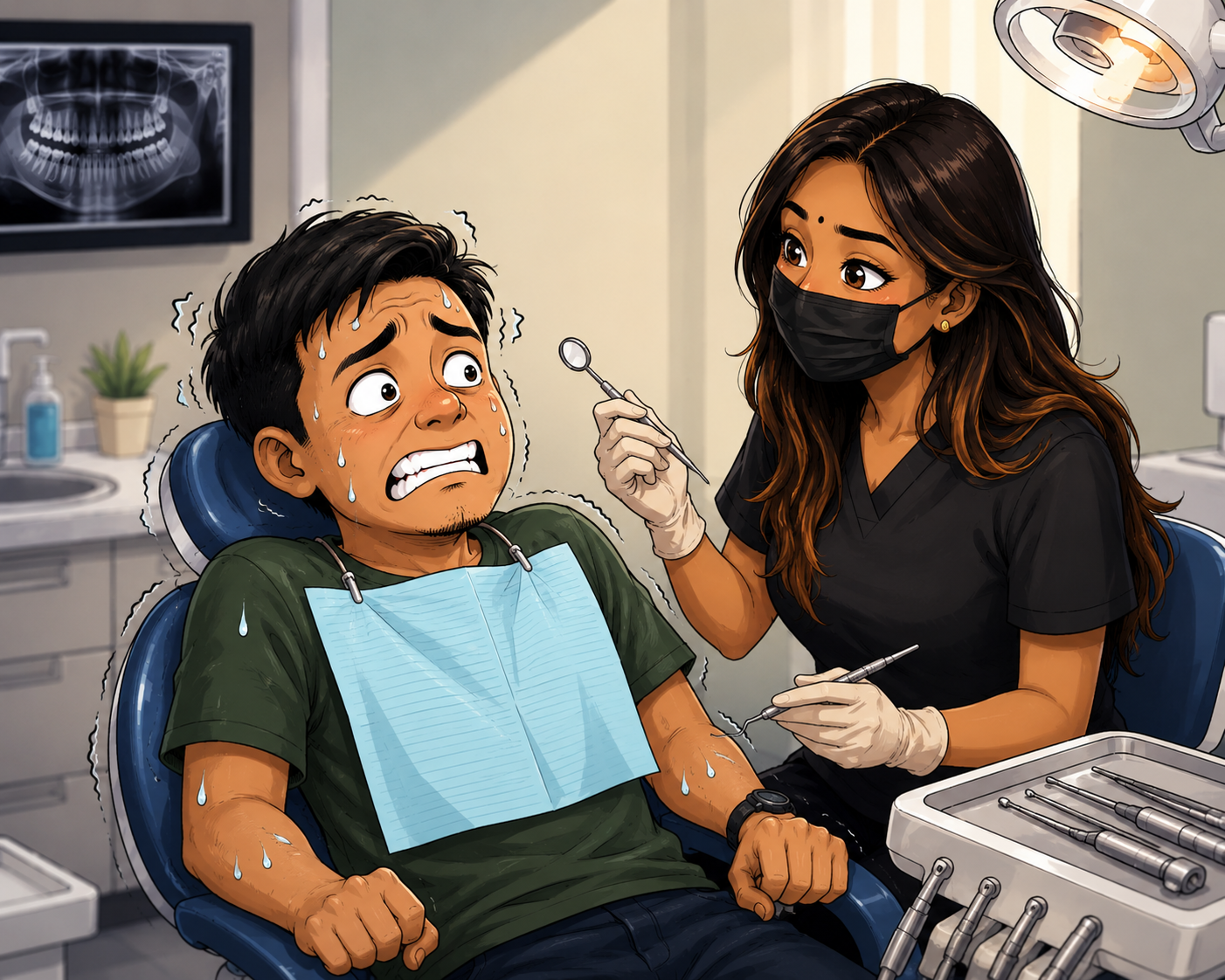
Dental anxiety is something we hear about in textbooks all the time, but seeing it in real life is a completely different experience. It is not just about being “scared of the dentist.” Some patients genuinely panic. Their hands shake, their legs bounce nonstop, and some suddenly become very interested in the clinic ceiling lights just to avoid eye contact with the dentist. I once saw a patient grip the dental chair so tightly during scaling that I thought the armrest might need restoration too.
The funny thing is, many anxious patients are actually very aware that they need treatment. They know the tooth has been hurting for months. They know the cavity has evolved into a “national issue.” Yet they still delay appointments because fear somehow becomes stronger than pain. One patient jokingly said, “I can survive toothache… but emotionally, I cannot survive the injection.”
And honestly, dental anxiety is more common than people think. Some patients develop it because of bad childhood experiences. Others are terrified of needles, the sound of drills, or simply the fear of not knowing what’s happening inside their mouth. There are also patients who feel embarrassed about the condition of their teeth. They apologize before the dentist even says anything. But what many patients don’t realize is that dentists are usually more focused on helping than judging.
One of the biggest misconceptions is that every dental visit equals pain. Modern dentistry has improved so much, yet the fear still remains. Sometimes the anticipation is worse than the actual procedure. I’ve seen patients spend an entire week worrying about a simple scaling appointment, only to finish treatment and say, “Wait… that’s it?” with genuine confusion on their face.
What surprised me most during clinics was how much communication changes everything. Patients become noticeably calmer when the dentist explains procedures gently, reassures them, and allows them to ask questions. A little empathy goes a long way. Sometimes patients are not afraid of the treatment itself, they are afraid of feeling helpless, embarrassed, or unheard.
There was also this one patient who kept saying, “I’m not scared ah,” while visibly sweating before local anesthesia. The dental assistant and I exchanged the kind of eye contact that says, “This man is absolutely terrified.” Five minutes later, after the injection was done, he looked shocked and said, “Eh, I didn’t even feel it.” That moment alone perfectly summarized dental anxiety: the fear before treatment is often bigger than the treatment itself.
At the end of the day, dental anxiety is real, and it deserves understanding rather than judgment. Sometimes patients are not difficult, they are simply frightened. As healthcare providers, learning how to manage fear with patience, reassurance, and kindness can make a huge difference in someone’s dental experience.
And for patients reading this: trust me, the dentist is probably less scary than Googling your symptoms at 2 a.m. after eating ice cream and feeling sudden tooth sensitivity.